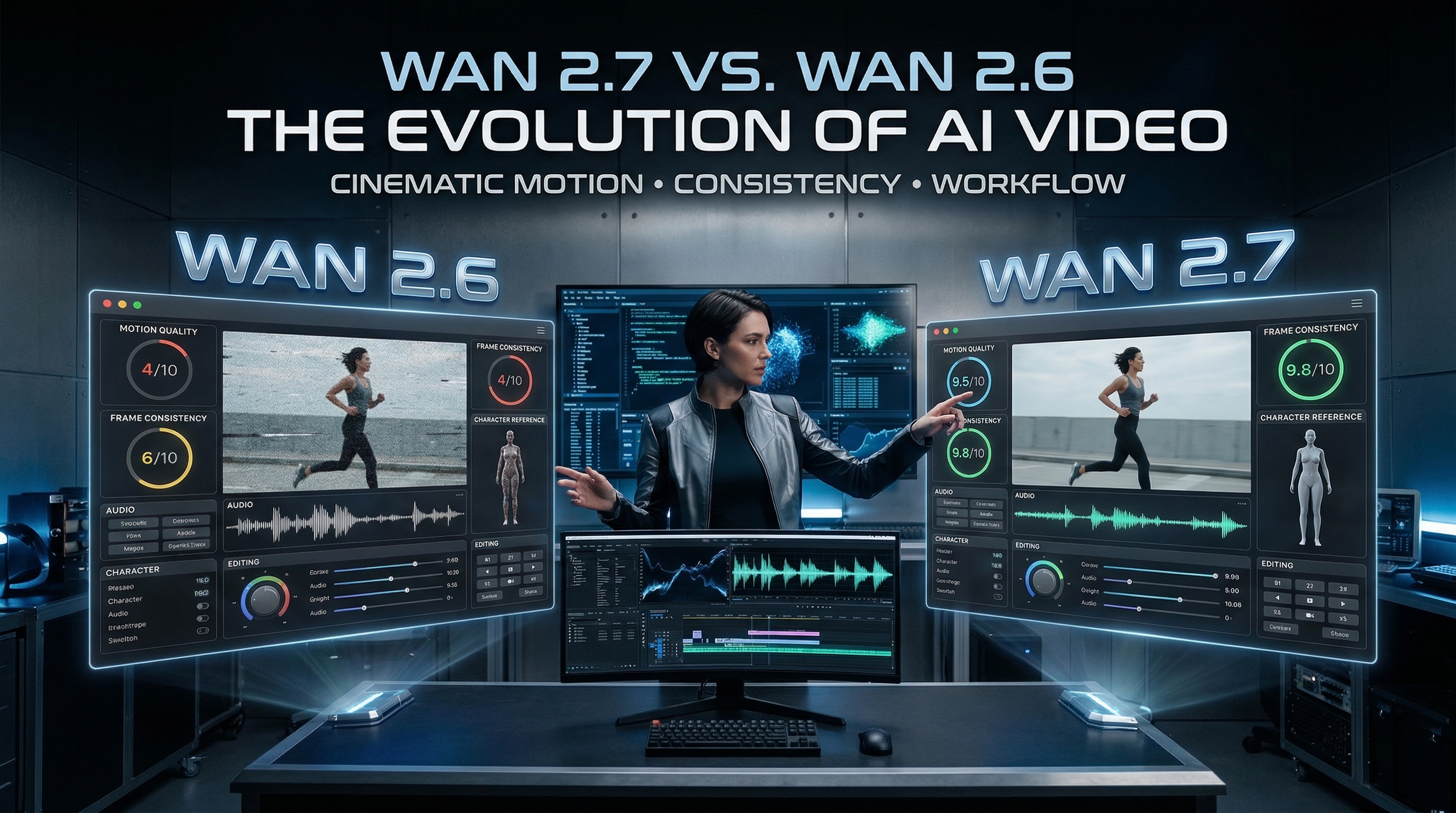
AI video creators are always looking for the next model that can save time, improve motion quality, and make prompts feel less like guesswork. That is exactly why so many people are now comparing Wan 2.7 with Wan 2.6. The big question is simple: does Wan 2.7 look like a real workflow upgrade, or is it mainly a polished follow-up to what Wan 2.6 already does well?
Right now, that comparison has to be handled carefully. Wan 2.6 is the clearer real-world benchmark because it is already available for practical use. Wan 2.7, by contrast, is attracting attention through recent upgrade reports and preview-style coverage. So the smartest way to look at this matchup is not just by version number, but by what actually changes for creators making short-form videos, ads, social clips, character-driven scenes, and cinematic AI content.
For anyone who wants to test the Wan workflow today instead of waiting, the most practical starting point is Wan 2.6 on Flux Pro AI.
Why Wan 2.6 Is Still the Right Baseline
Before talking about Wan 2.7, it helps to understand why Wan 2.6 already matters. Wan 2.6 is not just another AI video model with a new label. It is already positioned as a multimodal video generator built for creators who want more than simple motion experiments. In practice, that means it is designed for text-to-video, image-to-video, audio-aware generation, and more cinematic output styles.
That makes Wan 2.6 useful as a real benchmark. If a new version promises better motion, stronger consistency, and smarter editing control, creators need a current model to compare it against. That is where this Wan 2.6 AI video generator becomes helpful. It gives you a hands-on sense of what the Wan family can already do in a live workflow.
For many creators, that matters more than rumor alone. It is much easier to judge whether Wan 2.7 is a big upgrade once you already know how Wan 2.6 performs in prompt following, scene continuity, camera movement, and audio-linked generation.
What Wan 2.7 Is Supposed to Improve
The excitement around Wan 2.7 comes from a simple idea: it appears to be aiming for a broader, more creator-friendly workflow. Instead of only improving raw output quality, the reported direction suggests a model that may also give users better control over how videos are generated and refined.
The most discussed improvements include stronger visuals, smoother motion, better audio, richer stylization, and improved consistency. Those are exactly the categories that matter for AI video creators. Better visuals make clips feel more polished. Better motion reduces the strange or floaty movement that often breaks immersion. Better consistency is essential for character retention, scene continuity, and multi-shot storytelling.
Some of the most interesting reported Wan 2.7 features go even further. These include first-frame and last-frame control, 9-grid image-to-video workflows, subject and voice reference inputs, instruction-based video editing, and video recreation tools. If those features arrive in the way many creators expect, Wan 2.7 would feel less like a simple generation update and more like a more complete video-creation environment.
That is the key reason people are paying attention. A better generator is useful. A better workflow is much more valuable.
The Real Upgrade Question: What Changes for Creators?
For creators, the best comparison is not “2.7 is newer than 2.6.” The better question is: what becomes easier?
The first area is prompt reliability. If Wan 2.7 improves instruction following, creators may spend less time rerolling prompts and more time refining their ideas. This matters for ad creators, YouTubers, and marketers who need predictable results rather than lucky generations.
The second area is motion quality. Motion is still one of the biggest differences between average and strong AI video models. A model can generate beautiful frames, but if the motion looks awkward, stiff, or inconsistent, the clip becomes harder to use. If Wan 2.7 delivers smoother movement and more believable temporal consistency, that alone could feel like a meaningful upgrade over Wan 2.6.
The third area is subject consistency. This is especially important for creators making recurring characters, brand assets, product demos, or multi-shot visual stories. If Wan 2.7 really improves reference-driven outputs, then it could become more attractive for repeatable production work rather than one-off visual experiments.
The fourth area is audio integration. Better audio matters not just for lip-sync or dialogue, but for how a clip feels overall. When audio and visuals work together more naturally, creators spend less time fixing outputs in separate editing tools.
The fifth area is editing control. This may be the biggest difference of all. If Wan 2.7 truly adds first-frame and last-frame guidance, instruction-based video editing, and stronger reference controls, it may reduce the need to bounce between multiple tools just to get one usable result.
So, Is Wan 2.7 a Big Upgrade?
The honest answer is: it depends on how fully those reported control features arrive.
If Wan 2.7 only improves visuals, motion, and consistency, then it may still be a good upgrade, but more of a refined step forward than a complete shift. Creators would get cleaner outputs, but the overall workflow might still feel familiar.
If Wan 2.7 also delivers the more advanced control features people are talking about, then the upgrade could feel much bigger. In that case, the value would not be limited to prettier clips. It would come from having more control over timing, framing, references, and iteration. That kind of change can affect how creators plan projects, how quickly they reach usable results, and whether a model is practical for production rather than just experimentation.
So the size of the upgrade is not only about image quality. It is about how much friction disappears from the creative process.
Why Wan 2.6 Still Matters Even If Wan 2.7 Looks Better
Even if Wan 2.7 turns out to be a major improvement, Wan 2.6 still matters right now for one very practical reason: it is already usable.
Creators often need to make a decision before the next big release fully lands. They need a tool for current campaigns, demos, social media content, or internal concept work. In that situation, waiting for the perfect future model is often less useful than learning the strongest currently accessible one.
That is why Wan 2.6 on Flux Pro AI remains a strong recommendation. It gives creators a chance to test current Wan strengths today, including text-to-video and image-to-video workflows, while building a real baseline for judging Wan 2.7 later.
It also helps creators write better prompts. Once you understand how the Wan style handles movement, cinematic framing, and scene construction, it becomes much easier to evaluate whether the next version is truly better or simply different.
Should You Wait or Start Now?
If your main goal is to follow the latest AI video trends, it makes sense to keep an eye on Wan 2.7. It looks promising, especially for creators who care about stronger control, more stable characters, and more advanced reference-based workflows.
But if your goal is to make videos now, the smarter move is to start with a live model. This AI video generator with Wan 2.6 is the more practical option for creators who want to experiment today, learn the Wan workflow, and build a realistic benchmark before the next release becomes fully clear.
Final Verdict
Wan 2.7 looks like a meaningful upgrade if its reported improvements in motion, consistency, audio, and editing control arrive as expected. It has the potential to make the Wan workflow more complete, more controllable, and more useful for serious creators.
But Wan 2.6 is still the model that makes the comparison real. It is the version creators can actually test today, and that is why the best next step is not just to read about Wan 2.7, but to try Wan 2.6 on Flux Pro AI and see what the current Wan generation already offers.
Related Articles
- WAN 2.6 Tutorial: How to Create AI Videos with WAN AI
- Wan 2.6 vs Kling 2.6: Which Image-to-Video Model Wins in 2026?
- Wan 2.6 vs Sora 2: Is This the Next Big AI Video Rivalry?