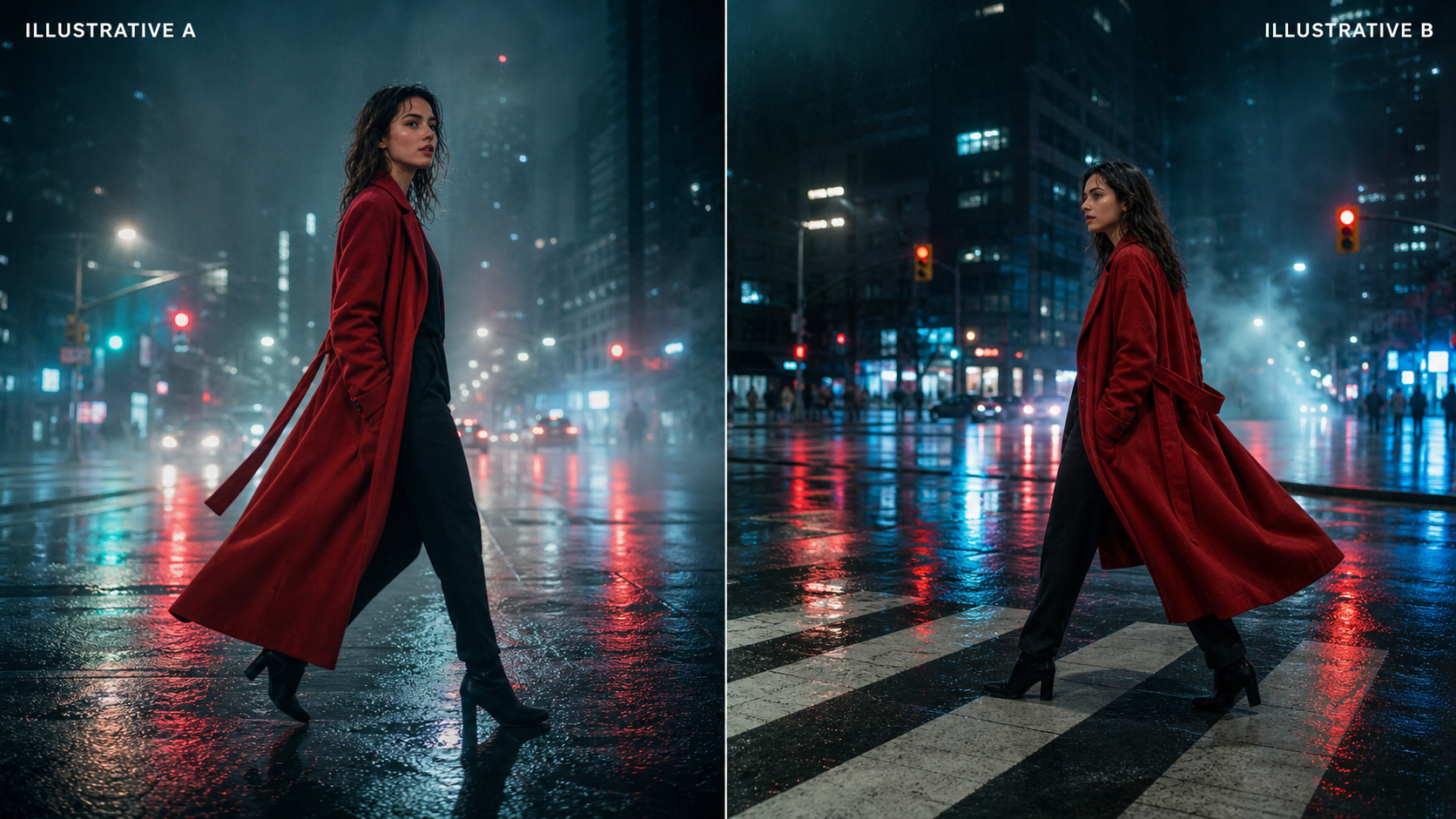
In a world where visual storytelling moves faster than ever, creators increasingly rely on AI tools to help them keep pace. Filmmakers need instant camera-angle variations for pre-viz. Storyboard artists need consistent character shots from different angles. Animators need geometry-accurate turnarounds. Product designers need to simulate multiple angles without expensive photography setups.
For years, the biggest limitation wasn’t style—AI models could stylize easily. The real bottleneck was perspective.
Images could be edited, but not rotated. Faces could be altered, but not turned. Products could be remixed, but never repositioned. AI simply didn’t “understand” the 3D geometry behind a 2D image.
That changed with Qwen Image Edit and its revolutionary camera-angle control system, which you can try directly via: 👉 qwen image edit camera angle control 👉 qwen-image-edit
Qwen Image Edit is the first consumer-accessible model that treats image editing like cinematography—reconstructing hidden geometry, repositioning the “camera,” and generating angles that look real instead of warped. And when run on Flux Pro AI’s optimized platform, the experience becomes not only cinematic but also production-ready.
This article explores what makes Qwen Image Edit so powerful, why camera-angle control is such a groundbreaking technology, real creative use cases, prompt strategies, and why Flux Pro AI is the best place to use the model.
I. Why Camera Angle Control is the Missing Piece of AI Creativity
Most image AI has gotten good at things like:
- lighting changes
- background replacement
- style transformation
- color grading
- inpainting and outpainting
But until now, one thing AI simply could NOT do well was:
→ Change the camera angle while preserving object identity.
Rotate a face 30° and it becomes another person. Tilt a product and the proportions collapse. Ask for “same character, different angle,” and the result becomes inconsistent.
For storytellers, product designers, animators, and filmmakers, angle control is everything. A change in perspective shifts mood, tension, clarity, or storytelling direction. A shot from below conveys power. A shot from above conveys vulnerability. A ¾ rotation reveals personality.
Qwen Image Edit solves this core problem with a geometry-aware reconstruction engine—bringing cinematic logic into AI editing for the first time.
II. What is Qwen Image Edit and How Does It Work?
Qwen Image Edit is a high-level, geometry-sensitive image editing model developed within Alibaba’s Qwen AI ecosystem. It is uniquely trained to:
- Understand three-dimensional object structure
- Predict unseen features with realistic probability
- Rebuild angles that aren’t in the original photo
- Simulate lens types, depth, and perspective
- Maintain subject identity across angle changes
- Re-render lighting realistically
- Avoid the “warped distortion” that plagues other models
Unlike typical diffusion-based editors, Qwen Image Edit doesn’t just repaint pixels—it recalculates geometry as if performing a 3D reconstruction. This enables dramatic yet accurate transformations such as:
- rotating a human head 30–90 degrees
- lifting the camera angle to eye-level
- lowering the camera for a heroic shot
- shifting between wide-angle and telephoto looks
- turning a product to reveal its front or sides
- generating cinematic close-ups with depth-of-field
And you can access all of this through: 👉 qwen-image-edit
This is why Qwen is quickly becoming a favorite for filmmakers and designers who need shots, not just images.
III. Why Camera-Aware Editing Changes Everything
A. For Filmmakers: Instant Pre-Viz Without a Studio
Qwen lets you:
- generate over-the-shoulder shots
- preview storyboard angles
- create shot-reverse-shot sequences
- test wide shots vs. close-ups
- create cinematic variations of a character or location
Instead of renting a camera, actors, and a set, you can produce angle variations instantly—even before production begins.
B. For Animators: Complete Character Rotation Sheets
Animators often need:
- front view
- profile view
- ¾ view
- low-angle view
- overhead view
Creating these from a single image used to require days of manual work. Now Qwen produces angle-accurate, identity-consistent variants in seconds.
C. For Product Designers: Photography Without the Studio
Qwen Image Edit can create:
- 45° top-down “hero” shots
- macro close-ups
- side angles
- low-angle branding perspectives
- environmental mood angles
This is ideal for:
- e-commerce
- Amazon listings
- packaging proposals
- promotional materials
You can experiment with 20 different angles before even making a prototype.
D. For Storyboard Artists: Seamless Sequential Frames
Qwen’s camera logic lets storyboarders:
- push in
- pull back
- tilt
- rotate
- shift sides
- mimic tracking shots
One photo becomes a full cinematic sequence.
IV. How Qwen Reconstructs Geometry Accurately
This is where Qwen stands apart from all other consumer AI editors.
1. Geometry-Aware Predictions
Qwen approximates facial or product structure beyond what’s visible.
2. Depth-Map Reasoning
It understands which parts are closer/farther and how perspective should change.
3. Lens Simulation
Qwen interprets the request like a cinematographer—not like a painter.
4. Identity Preservation
Even across drastic angle changes, characters stay recognizable.
Other models warp features. Qwen builds structure.
You can test this visually at: 👉 qwen image edit camera angle control
V. Real Use Cases: How Creators Are Using Qwen Today
1. Actor Rotation for Casting Decks
Casting directors use Qwen to show what actors look like from varied angles—without asking them to submit multiple photos.
2. Full Character Sheets for Games
Indie developers generate consistent angles for their main characters, NPCs, enemies, and bosses.
3. Product Photography Prototyping
Tech companies generate 30 different views of a new device from a single CAD image.
4. Storyboard Angle Variants for Pitches
Agencies build pitch decks with multiple angle variations of locations, scenes, or characters.
5. YouTube Thumbnail and Branding Shots
Marketers use Qwen to simulate different camera distances and emotional impact angles.
VI. Why Use Qwen Image Edit on Flux Pro AI?
You could theoretically run Qwen anywhere—but using it on Flux Pro AI (https://fluxproweb.com/qwen-image-generator/) gives you significant advantages.
1. The Backend Is Optimized for Qwen Models
Flux Pro AI is engineered for:
- angle-heavy computation
- geometry reconstruction
- multi-pass identity-preservation
You get fewer distortions and better angle accuracy.
2. Clean Cinematic UI Designed for Artists
The interface supports:
- ratio selection
- prompt templates
- face & character uploads
- multi-angle generation
- quick comparisons
Ideal for filmmakers, designers, and animation studios.
3. Integration With Seedream 4.0 and Other Pro Models
Flux Pro AI is a multi-model ecosystem.
You can:
- Use Qwen Image Edit for the perfect camera angle.
- Then use Seedream 4.0 for 4K cinematic enhancement.
- Then finalize via Flux Ultra for style consistency.
This pipeline produces results you cannot achieve on any single-model platform.
4. Faster, More Stable Angle Reconstruction
Many platforms time out or distort when angles become too complex.
Flux Pro AI runs Qwen with:
- higher frequency success
- cleaner geometry
- fewer identity issues
- consistent production-grade results
5. Suitable for Commercial Projects
Flux Pro AI provides clear licensing and stable, high-quality outputs usable for:
- professional pitch decks
- client presentations
- YouTube/brand work
- market testing
VII. Qwen vs Other Editing Models: A Comparison
Qwen vs Midjourney Edit
- MJ focuses on stylization, not angle logic.
- Qwen treats camera angles like a film tool.
Qwen vs Runway
- Runway is strong in video, weaker in per-frame geometry accuracy.
- Qwen dominates static-angle reconstruction.
Qwen vs Photoshop Generative Fill
- Photoshop is excellent for realism but terrible at camera-angle transformation.
- Qwen fills this exact gap.
VIII. Prompt Guide: How to Control Camera Angles in Qwen
1. Low-Angle Heroic Shot
“Low-angle shot, upward tilt, wide lens 35mm, cinematic lighting, same character identity.”
2. ¾ Rotation View
“Rotate to ¾ view, maintain facial structure, soft depth-of-field.”
3. Product Macro Shot
“Close-up macro, top-down 45°, realistic lighting, product hero angle.”
4. Storyboard Reverse Angle
“Reverse-angle shot, matching identity, same lighting, cinematic frame.”
More examples can be added upon request.
IX. How to Use Qwen on Flux Pro AI (Step-by-Step)
1. Upload Your Subject
Character photo, product shot, sketch, etc.
2. Enter Angle Instructions
Rotate, tilt, elevate camera, widen lens, add depth—be specific.
3. Adjust Ratios
1:1, 16:9, 9:16, or cinematic widescreen.
4. Add Optional Style Prompts
Film look, color grading, dramatic lighting.
5. Generate & Compare Variations
Flux Pro produces consistent variations quickly.
X. The Future of Cinematic Editing with Qwen
Qwen represents the next leap in image editing—AI that behaves like a cinematographer. Soon, we may see:
- full 360° character reconstruction
- multi-shot automatic storyboards
- AI-assisted film previsualization pipelines
- 3D reconstruction directly from 2D images
- AI that handles continuity across entire scenes
We are stepping into an era where AI supports—not replaces—creative direction.
XI. Conclusion: The Beginning of Camera-Smart AI
Qwen Image Edit is not just another editing tool. It is the world’s first accessible camera-aware AI editor—the missing link between static images and cinematic storytelling.
Its ability to simulate real camera angles makes it invaluable for:
- filmmakers
- storyboard artists
- animators
- product designers
- digital marketers
- game developers
And when used on Flux Pro AI, creators gain the fastest, most stable, most cinematic version of Qwen available.
If you want to transform your static images into film-ready shots:
👉 Try the qwen image edit camera angle control https://fluxproweb.com/qwen-image-generator/
👉 Explore qwen-image-edit for cinematic transformations https://fluxproweb.com/qwen-image-generator/
This is where AI stops being a drawing tool—and becomes a director’s tool.
If you want, I can also:
✔ Turn this into polished Markdown ✔ Generate SEO title, meta description, tags ✔ Create section image prompts ✔ Prepare a shorter LinkedIn/X version
Just let me know!